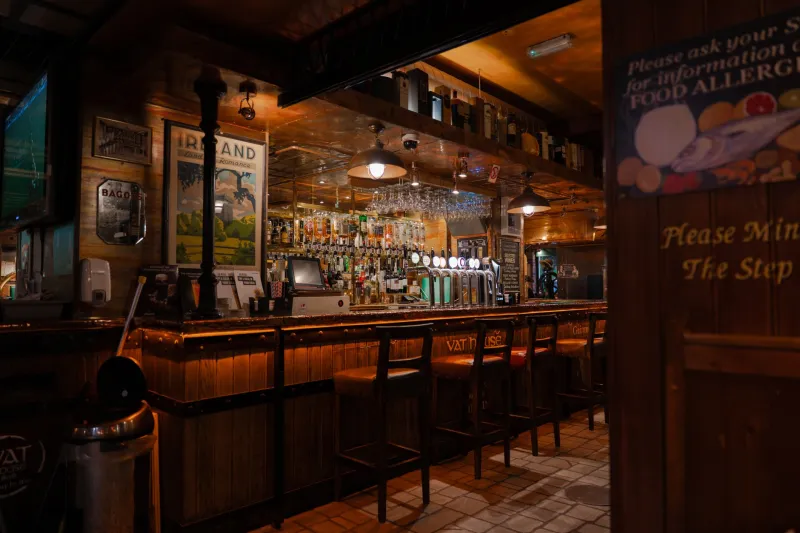
Why Does a Pint in Dublin Feel Like It Comes With More? The Real Cost of Irish Hospitality
You've ordered a round at a British pub. The bar staff are efficient, perfectly pleasant, and almost certainly busy. Your drinks arrive. Change is given or a card machine is presented. The transaction completes. You return to your table.
You've ordered a round in Temple Bar. The bar staff are also efficient and also perfectly pleasant. But somewhere in the process — between the order and the change — something else happened. A question was asked. A recommendation was offered without being pushed. A comment was made about the weather, or the match, or where you're from, that somehow didn't feel like small talk. By the time you're back at your table, you feel, inexplicably, slightly better about the evening than you did thirty seconds ago.
This is the thing that UK visitors to Dublin's Temple Bar consistently struggle to articulate. The service isn't objectively faster or more technically accomplished than what they get at home. But it feels different. More generous, somehow. More like being welcomed than processed.
So what's actually going on?
The Unhurried Pint Is a Philosophy, Not an Accident
The most immediately visible difference between Irish pub service and its British equivalent is pace. In Temple Bar, nobody appears to be in a hurry — not in a way that suggests incompetence, but in a way that suggests the bar staff have decided the person in front of them is worth their full attention for as long as the interaction takes.
This isn't accidental. It reflects a genuinely different philosophy about what a bar is for. In much of the UK, pub service culture has been shaped by the economics of throughput — how many covers can be served per hour, how quickly the bar can be cleared between rounds. Efficiency is the metric. In Dublin, the metric is something closer to satisfaction, and satisfaction — real satisfaction, the kind that brings people back — takes a little longer to manufacture.
The famous two-part pour of a Guinness is often cited as the practical expression of this philosophy. Yes, the nitrogen-and-CO₂ blend requires a settling period for the best result. But the two-minute wait also does something to the relationship between bar staff and customer. It creates a natural pause — a moment in which conversation can happen, or eye contact can be held, or a recommendation can be floated. The drink becomes an occasion rather than a transaction.
Knowing When to Talk and When to Leave You Alone
Here's where it gets genuinely sophisticated. Because the other side of Irish hospitality — the side that often goes unnoticed until you've experienced its absence — is the ability to read a room at the individual level.
A good Temple Bar bar worker can clock, within seconds of someone approaching the bar, whether they want a chat or a quiet drink. Whether they're celebrating or processing something difficult. Whether they're locals who've been coming in for years or visitors who don't quite know what they're looking for yet. And they calibrate accordingly.
This is a skill. It takes time to develop, and it requires a kind of emotional intelligence that no training manual can fully teach — though the best venues in Temple Bar absolutely try. The instinct to engage is trained alongside the instinct to hold back, and the result is a form of service that feels attentive without being intrusive.
For UK visitors, particularly those from larger cities where bar interactions tend toward the transactional, this calibration can feel almost startlingly personal. You weren't expecting to feel seen. But you do.
The Economics Nobody Talks About
Here's the part that complicates the picture: genuine hospitality is expensive.
The staffing ratios required to deliver this kind of attentive, unhurried service are higher than what a throughput-focused model demands. The training investment is greater. The expectation that staff will stay longer, learn the regulars, and develop real relationships with the community they serve means higher turnover costs when people leave.
Drinks in Temple Bar are not always cheap by UK standards — particularly in the more well-regarded venues. And visitors sometimes balk at that, comparing the price of a pint to what they'd pay at their local back home. But the comparison misses something important. What you're paying for in Temple Bar isn't just the liquid in the glass. It's the infrastructure of an experience — the staffing, the training, the physical warmth of a well-maintained venue, and the invisible labour of making you feel welcome in a way that persists after you've left.
Tipping culture in Ireland, while not as mandatory as in the United States, reflects this understanding. Visitors who've had a genuinely good experience tend to tip generously — not out of obligation, but because the exchange has felt like more than a commercial one.
What British Pub Culture Does Differently (And Why That's Not a Criticism)
None of this is to suggest that British pub culture is cold or unwelcoming — it absolutely isn't. The British local has its own forms of warmth: the familiarity of a regular's stool, the unspoken rituals of round-buying, the particular comfort of a pub that hasn't changed in thirty years.
But the British model has, in many cases, been squeezed by economic pressures — rising rents, reduced margins, and a hospitality sector that has spent the better part of a decade in crisis. The result is often service that is warm in intention but stretched thin in practice. Staff are doing their best with less time and fewer people than the job actually requires.
Temple Bar operates under its own economic pressures, of course. But the cultural expectation of what hospitality means here has remained more intact — more resistant to the kind of efficiency-first thinking that strips the soul from a service interaction.
What It Feels Like to Be on the Right Side of It
Ask any UK visitor who's spent a proper evening in Temple Bar what they remember most, and the answer is rarely the specific drink or the particular venue. It's a feeling. A sense that the evening went better than planned, that the city was more welcoming than expected, that they were — briefly, genuinely — made to feel at home somewhere that wasn't home.
That feeling has a price. It's built into every round, every recommendation, every two-minute pause while the Guinness settles.
Most people who've experienced it would tell you, without hesitation, that it's worth it.